
News

ATHENE-Paper accepted at the CHI 2024
ATHENE researchers will present their papers at the prestigious ACM CHI Conference on Human Factors in Computing Systems, CHI for short. CHI is the premier international conference on human-computer interaction and serves as a platform for researchers, practitioners and industry leaders to share their latest work and ideas and foster collaboration and innovation in the field.
read more
ATHENE researchers discover serious security vulnerabilities in Internet routing protection software
A research team from the National Research Center for Applied Cybersecurity ATHENE led by Prof. Dr. Haya Schulmann has uncovered 18 vulnerabilities in crucial software components of Resource Public Key Infrastructure (RPKI). The affected vendors have been provided with patches for their products.
read more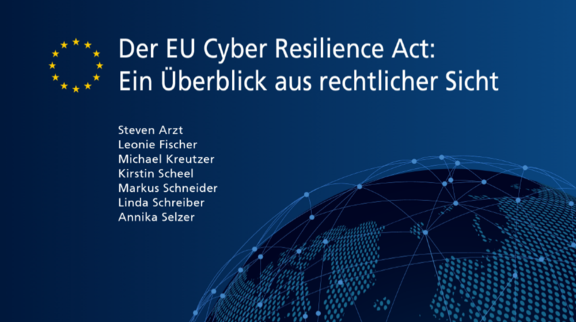
ATHENE publishes white paper on the CRA
Connected products are to become more secure across the EU - that is the aim of the Cyber Resilience Act (CRA), an EU regulation that is currently being voted on and is expected to come into force this year. In our latest whitepaper, our researchers address the latest version of the CRA draft and explain which companies and products are likely to be subject to which obligations.
read more
Accepted papers at the EACL 2024
ATHENE researcher Prof. Iryna Gurevych presented seven papers at the 8th Conference of the European Chapter of the Associations for Computational Linguistics, EACL for short. Two of them were directly related to her research work in the ATHENE research project "Fake News and Conspiracy Theories" from the research area Secure Digital Transformation in Health Care ( SeDiTraH). EACL is one of the leading European conferences in the field of computational linguistics covering a broad spectrum of research areas that are concerned with computational approaches to natural language.
read more
Prof. Iryna Gurevych becomes a member of the Leopoldina
Prof. Iryna Gurevych from TU Darmstadt has been appointed to the German National Academy of Sciences Leopoldina. This gives her one of the highest scientific honors that a German institution can bestow, as the world's oldest permanently existing academy of natural sciences unites only researchers with outstanding scientific achievements under its roof. With around 1.600 members, it provides independent, science-based political advice on future social issues and represents German science abroad. New members undergo a strict, multi-stage selection process.
read more