
News
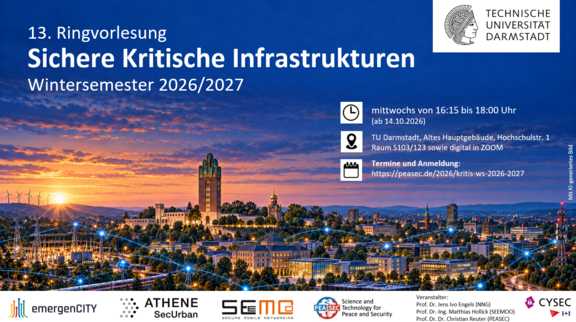
Kickoff of the “Secure Critical Infrastructure” Lecture Series in the 2026/2027 Winter Term
The 13th lecture series in the “Secure Critical Infrastructure” programme is taking place this winter semester. To kick things off, Prof. Dr. Dr. Christian Reuter, a researcher at ATHENE, will introduce the lecture series and the topic of securing critical infrastructure on October 14.
The series will address various critical infrastructures and their security challenges. Speakers from research institutions, companies, government agencies and critical infrastructure operators have been invited to give specialised presentations on specific aspects of the topic. The 'Secure Critical Infrastructures' lecture series is organised by ATHENE researchers Prof. Dr.-Ing. Matthias Hollick, Prof. Dr. Dr. Christian Reuter and Prof. Dr. Jens Ivo Engels.

How AI-Generated Code is becoming more secure from the ground up: A conversation with Prof. Dr.-Ing. Mira Mezini about SecureCoder
Although more than 90 percent of software developers use AI-powered programming tools today, a significant proportion of the generated code contains security vulnerabilities. The ATHENE SecureCoder mission project is taking a new approach. Rather than verifying security after the fact, it should be built into AI-assisted code generation from the very beginning. In an interview, project leader Prof. Dr.-Ing. Mira Mezini explains how this will be achieved.
read more
Successful Submission at Crypto 2026
As the flagship conference of the International Association for Cryptologic Research (IACR), the International Cryptology Conference—known as Crypto for short—is one of the world’s leading academic events in the field of cryptography. A paper co-authored by ATHENE researcher Prof. Dr. Sebastian Faust of TU Darmstadt, along with other researchers from the University of Warsaw, the IDEAS Institute, and the Institute of Science and Technology Austria, will be presented at this highly regarded conference.
read more
Paper accepted at USENIX Security 2026
The USENIX Security Symposium is one of the world’s most prestigious cybersecurity research conferences, bringing together researchers, practitioners and developers each year to present and discuss the latest findings on security and privacy in computer systems and networks. Once again this year, papers co-authored by ATHENE researchers from TU Darmstadt have been accepted for presentation at this prestigious conference.
read more
Successful submissions to ACL 2026
At the annual meeting of the Association for Computational Linguistics (ACL), ATHENE researcher Prof. Dr. Iryna Gurevych and her colleagues presented numerous research papers. A paper co-authored by ATHENE researchers Prof. Dr. Anna Rohrbach and Prof. Dr. Marcus Rohrbach was also honored with the Best Resource Paper Award. This highly regarded conference brings together researchers and experts in the field of computational linguistics and language technology (natural language processing) to discuss the latest developments in this area.
read more
Contact
Clara Pfeuffer
ATHENE Digital Hub Cybersecurity
ATHENE Digital Hub Cybersecurity