
News
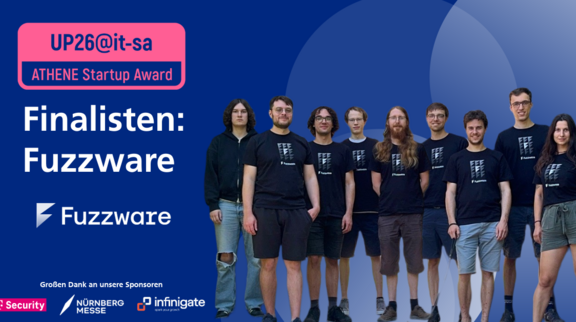
ATHENE UP26@it-sa finalists: An interview with Fuzzware
On stage in Miami, the team hacked into the US power grid live and realised afterwards that critical infrastructure needs more robust security testing. Today, Fuzzware automatically tests the firmware of embedded systems for vulnerabilities, without the need for a physical device or source code. In this interview, the founders explain how a successful hack led to the creation of a company – and what the most difficult step in the process was.
read more
ATHENE Startup Award UP26@it-sa: Five finalists have been selected
The finalists for the ATHENE Startup Award UP26@it-sa have been selected. Fuzzware, SQUR, Complioty, RedCastle and Blindsight will compete against each other in the final on 28 October 2026 as part of the it-sa Expo & Congress in Nuremberg. This annual award recognises the most promising cybersecurity start-ups in the DACH region.
read more
Prof. Dr. Dr. Christian Reuter on the FAZ’s STIFTOPHON podcast: Was macht Infrastruktur resilient?
In this episode of STIFTOPHON, Prof. Dr. Dr. Christian Reuter discusses critical infrastructure, cascade effects, and the role that civil society can play.
read more
Award for outstanding scientific achievement for a master's thesis on the safety of underwater data cables
Martin Hagemeier was awarded the Prize for Outstanding Scientific Achievement by the Association of Friends of the Technical University of Darmstadt (Vereinigung von Freunden der Technischen Universität zu Darmstadt e.V.) for his master’s thesis.
read more
Study: The external vulnerabilities of federal ministries' IT systems
Just how secure are the IT systems of federal ministries? A recent ATHENE study assessed their external attack surface and revealed significant gaps in their current security posture.
read more
Contact
Clara Pfeuffer
ATHENE Digital Hub Cybersecurity
ATHENE Digital Hub Cybersecurity