
News
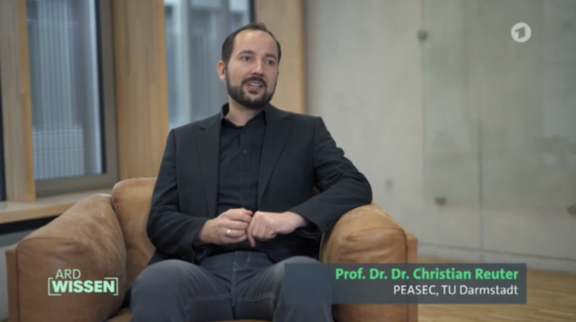
ATHENE reserach in the ARD
In the new ARD documentary "ARD Wissen: Deutschland im Ernstfall: Wie schützen wir unsere Infrastruktur?", ATHENE researchers Prof. Christian Reuter, head of the ATHENE research area "Secure Urban Infrastructure (SecUrban)" and Dr. Marc-André Kaufhold report on their research on automated collection of public data sources and data evaluation with credibility analysis and information prioritization. Thisr research was conducted as part of the CYWARN project and the ATHENE research area Secure Urban Infrastructure (Securban).
read more
Whitepaper on "Active Cyber Defense"
As a result of the Russian attack on Ukraine, the discussion about active cyber defense has also flared up again. Politicians are calling for improved capabilities. In their white paper "Active Cyber Defense" our CEO Prof. Michael Waidner and our cybersecurity expert Prof. Haya Shulman provide concrete examples of the technical options available for improving cyber defense in Germany.
read more
ATHENE researchers present document protection with colorful barcode
At this year's it-sa in Nuremberg, Fraunhofe SIT is showcasing DocSeal, a new solution for protecting against document forgery that enables companies and public authorities to quickly and easily add anti-counterfeiting protection to digital and paper documents. For this purpose, a colorful barcode (JAB Code) is printed on the document, which records important document contents and their placement in the document in a tamper-proof manner. An app can then be used to check document authenticity and automatically detect tampering.
read more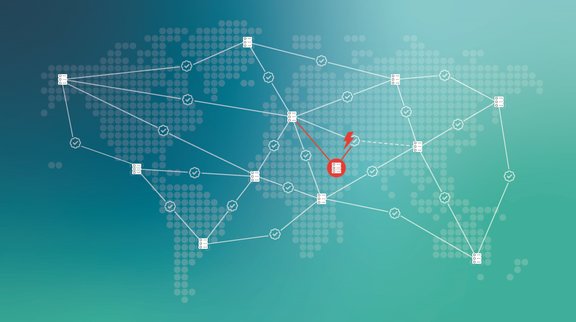
RPKI is insecure - Mechanism for Internet security broken
ATHENE has found a way to break one of the basic mechanisms used to secure Internet traffic. The mechanism, called RPKI, is actually designed to prevent cybercriminals or government attackers from diverting traffic on the Internet. Such redirections are surprisingly common on the Internet, e.g., for espionage or through misconfigurations. The ATHENE scientist team of Prof. Dr. Haya Shulman showed that attackers can completely bypass the security mechanism without the affected network operators being able to detect this. According to analyses by the ATHENE team, popular implementations of RPKI worldwide were vulnerable by early 2021. The team informed the manufacturers, and now presented the findings to the international expert public.
read more
Client Side Scanning and Deep Perceptual Hashing Vulnerabilities
ATHENE scientists at TU Darmstadt have identified significant vulnerabilities and manipulation possibilities in client-side scanning and deep perceptual hashing. The process came into focus when Apple introduced "NeuralHash" in 2021, a new approach to detecting child abuse imagery, but withdrew the introduction after massive criticism. The research results of the scientists now prove the dangers of client-side scanning methods for users.
read more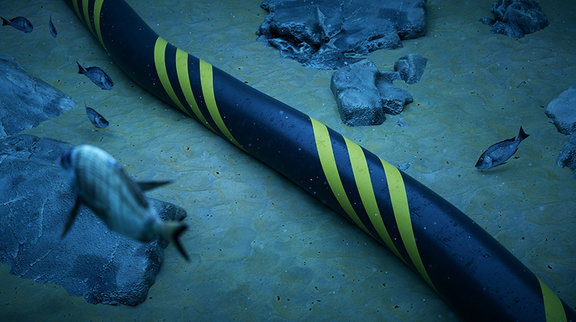
Fragile protection of our communications via submarine cables
ATHENE researchers study states' vulnerability to submarine cable failures
Today, we take it for granted that we can call up a website, stream a movie or be active in social networks within seconds. Many people are often unaware that the data transfer takes place via thousands of kilometers of cable laid at the bottom of the ocean. Today, around 98 percent of international Internet traffic is handled via undersea communication cables. Coastal and island states are highly dependent on this physical infrastructure to provide Internet connections. However, although an annual average of about 100 submarine cable failures of human or natural origin occur, there is currently no global analysis that assesses the vulnerability of individual states to failures on a global scale.
ATHENE scientists Jonas Franken, Thomas Reinhold and Prof. Christian Reuter from the Chair of Science and Technology for Peace and Security (PEASEC) at TU Darmstadt have tackled this issue.

Contact
Clara Pfeuffer
ATHENE Digital Hub Cybersecurity
ATHENE Digital Hub Cybersecurity